Can ChatGPT be trusted for pet health advice? A Vetster vet put it to the test and found some serious risks



Your dog throws up in the middle of the night. Your cat suddenly stops eating. Before you call a vet, there’s a good chance you ask ChatGPT what to do.
For many pet owners, using AI to answer health questions has become commonplace. In fact, nearly half of the estimated 330 million prompts that ChatGPT handles every day from U.S. users are questions.
Our veterinarian put ChatGPT to the test using some of the most commonly searched pet health questions. What they found were examples of hallucinations, oversimplified advice, and answers that sounded confident even when important information was missing.

How we tested ChatGPT
Using the search data tool, AlsoAsked, we identified ten of the most commonly searched pet health questions and asked our veterinarian to complete their analysis while logged out of ChatGPT to reduce personalization bias.
They didn’t simply check for accuracy. They evaluated whether the advice would help real pet owners make safe decisions about their pet’s health.
Key risks identified
ChatGPT wasn’t entirely wrong on most answers, but our veterinarian noticed a pattern of the same concerns:
- Failure to recognize emergencies
- Assumptions about the problem
- Overconfident answers even when key information was missing
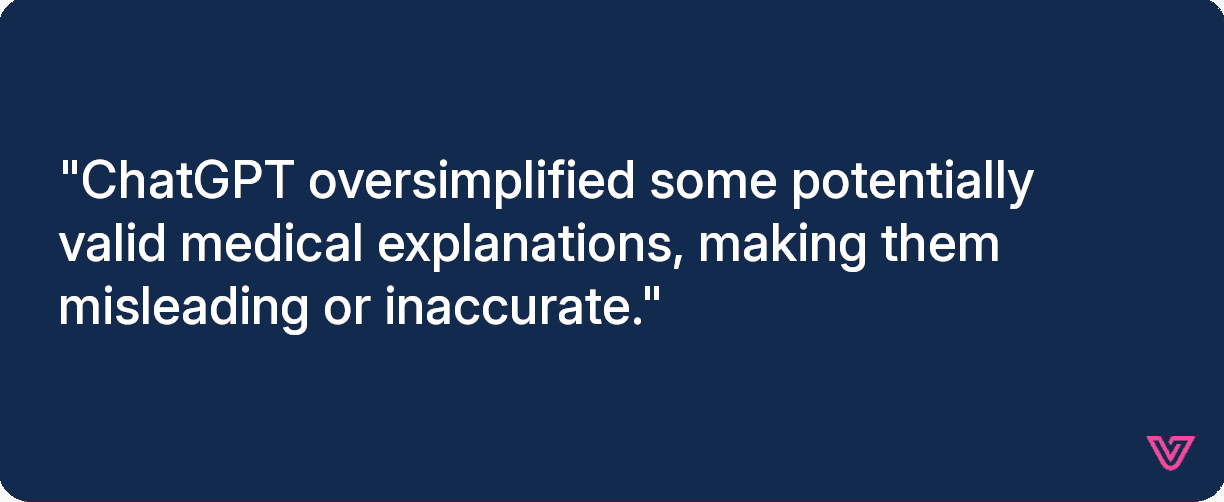
- Oversimplification of potentially valid explanations, making them misleading or inaccurate
- Potential diagnoses without sound clinical judgment
- Treating potentially unreliable information as fact
What our vets found
1. My cat stopped eating today. Is that an emergency?
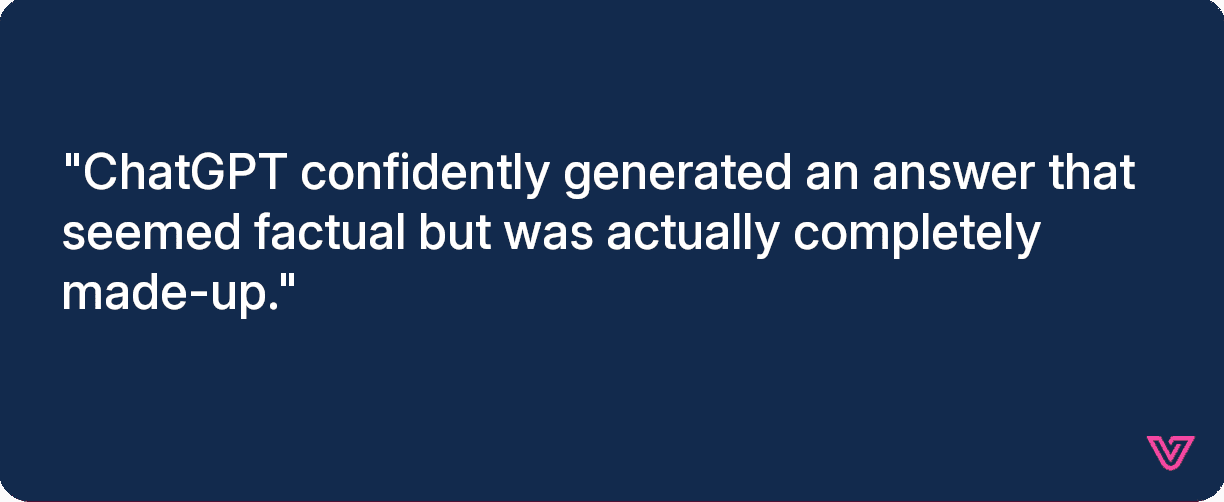
The problem: ChatGPT hallucinated the cat was a Bengal and introduced false information about the breed being food-motivated.
ChatGPT's answer
It listed symptoms that could make the situation more urgent and suggested that if the cat seems normal, the owner should offer a different food, warm it up, check their mouth for redness, and make sure water intake is normal. Calling a veterinarian was then advised if 24 hours pass and the owner feels something is off.
Our vet’s analysis
While immediately concerned that ChatGPT invented details about the cat's breed and eating habits, Dr. Jo Myers, a Vetster vet, also notes: “The answer moved too quickly into giving specific at-home instructions for owners without first understanding why the cat was not eating. A cat not eating for 24 hours could represent anything from mild stress to severe pain, toxin exposure, liver disease, or another potentially life-threatening condition. Consider the risk of spending the next 24 hours trying home suggestions, only to later learn that your cat’s underlying condition had progressed to a critical or even fatal stage during that delay.”
2. What is a ball-like lump on a cat?
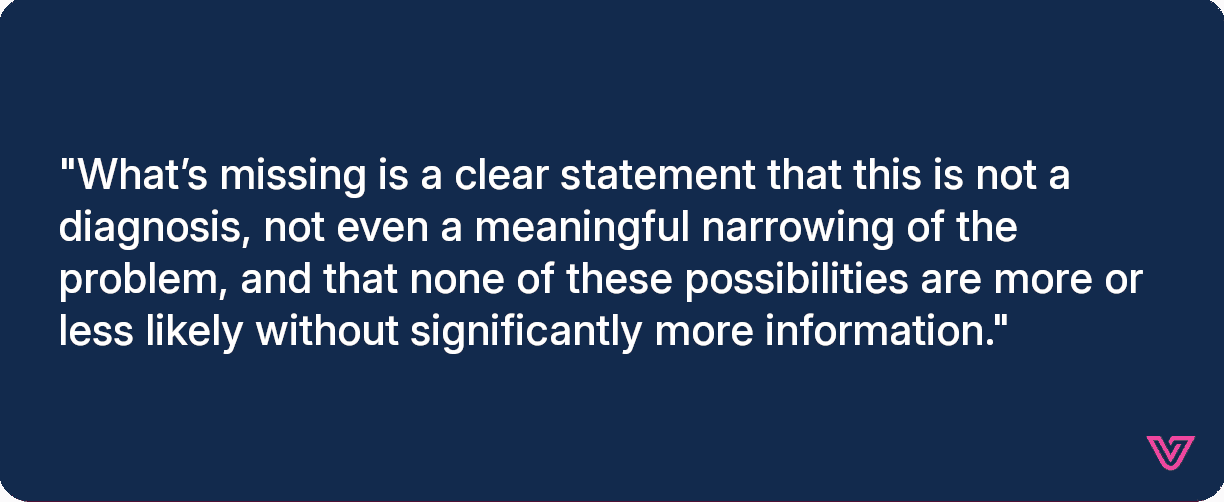
The problem: ChatGPT offered possibilities without enough information to meaningfully narrow down the cause.
ChatGPT's answer
The response listed common possibilities for a lump, including a lipoma, abscess, cyst, or tumor. It also advised owners on when to be concerned, such as if the lump was growing quickly.
Our vet’s analysis
Dr. Jo explains: “In real veterinary medicine, context is important. Details like the cat’s age, weight, medical history, whether they go outdoors, geographic location, how quickly the lump appeared, and even the exact feel and location when examining the bump are critical. Without that, this is just a broad differential list. As an example, I’ve seen cases where the pet came in for ‘a lump’ that turned out to be a bone fracture.”
3. Why does my dog have a bump that comes and goes?
The problem: ChatGPT identified what could be causing the bump, even though it didn't actually have enough information to do so.
ChatGPT's answer
ChatGPT listed the likely possibilities for a bump that comes and goes on a dog, including an allergic reaction, insect bites, fluid-filled swelling, cysts or a fatty lump (lipoma). It also advised owners to call a veterinarian given a few scenarios, such as if the bump keeps returning.
Our vet’s analysis
Dr. Jo says: “Many different conditions can appear to change in size or seem intermittent to an owner, especially depending on swelling, positioning, fur coat changes, or how closely the area is being monitored. The ‘come and go’ pattern might suggest certain possibilities, but it doesn’t meaningfully rule out other options. Without an exam and history, you cannot narrow things down.”
4. Is it normal for my dog not to sleep?
The problem: ChatGPT’s answer sounded complete, but it failed to clarify what the owner actually meant.
ChatGPT's answer
ChatGPT stated it isn’t normal for a dog not to sleep, listing common explanations such as stress, anxiety, or age-related behavior. It also advised owners to call a vet if the dog isn’t resting most of the day or night.
Our vet’s analysis
A vet would normally ask follow-up questions to understand what could be going on. Dr. Jo adds: “While stress, anxiety, or environmental changes may contribute to disrupted sleep, potentially serious medical causes must also be considered depending on the clinical picture. If a dog is showing marked restlessness or inability to settle, especially if the behavior is sudden, persistent, or accompanied by signs like panting, pacing, tremors, vomiting, agitation, or an elevated heart rate, it raises concern for medical emergencies.”
5. Why does my dog follow me everywhere?
The problem: The answer sounded more certain than it should have.
ChatGPT's answer
ChatGPT described this behavior as “super common” and suggested reasons for this that included bonding, the dog reading cues, reinforced behavior, curiosity, or boredom. It also recommended training and enrichment if the dog showed signs of separation distress.
Our vet’s analysis
Though ChatGPT’s explanations are all things veterinarians or trainers might discuss with owners, Dr. Jo explains: “One challenge with AI-generated answers is that they often present subjective or generalized interpretations with a level of confidence that can make them sound more certain than they really are. In this case, the advice was unlikely to cause harm, but pet owners should still understand that an AI system is not actually observing the dog, assessing the home environment, or professionally evaluating the behavior.”
6. Why is my cat or dog vomiting so often?
The problem: ChatGPT moved too quickly into giving advice without understanding the cause of the vomiting.
ChatGPT's answer
We asked separate questions for cats and dogs. In both cases, ChatGPT recommended pausing food, reintroducing bland food, and feeding smaller portions. It also suggested possible causes and advised owners to call a veterinarian if the animal was vomiting, lethargic, refusing food or water, drinking excessively (for cats), or had abdominal swelling (for dogs).
Our vet’s analysis
Our veterinarian acknowledged that some of ChatGPT’s recommendations, such as introducing a bland diet or smaller meals, could be appropriate for straightforward cases of vomiting. However, without more details about the pet’s medical history, symptoms, or the underlying cause, ChatGPT’s advice could be potentially risky. For cats especially, other medical causes of recurrent vomiting should be considered.
Dr. Jo explains: “This is where AI-generated advice can become problematic. It often provides actionable recommendations before establishing what problem may actually be occurring. The answer sounds reassuring and complete, but lacks the medical judgment needed to determine which possibilities are most urgent and whether immediate veterinary care may be necessary.”
7. What food can my cat or dog not have?
The problem: ChatGPT simplified food toxicity, when it’s actually complex.
ChatGPT's answer
Again, we asked two separate questions for cats and dogs. ChatGPT grouped foods into categories based on toxicity and advised owners to call a veterinarian if the animal showed symptoms such as vomiting or diarrhea. It also suggested this if the dog had eaten anything from the toxic list, or if an unknown food had been eaten. However, for cats, it recommended some safe alternative treat options.
Our vet’s analysis
Our veterinarian was concerned that the list of toxic foods seemed comprehensive, but pet owners may wrongly assume that foods not mentioned are safe. While ChatGPT correctly identified many common foods that cats and dogs should not eat, the response made food safety appear black-and-white, when in reality, it’s more nuanced.
Dr. Jo explains: “Context is critical in toxicology. For example, while chocolate toxicity is a real concern in dogs, the actual danger depends on the type of chocolate and the amount ingested relative to the dog’s size. When a pet may have eaten something toxic, time can matter. When the amount ingested or level of risk is uncertain, AI-generated advice should not recommend delaying contacting a veterinarian or animal poison control center.”
8. Can I give my dog some of my pain reliever? How much to give?
The problem: ChatGPT made medication safety seem more clear-cut than it actually is, overlooking key details that can change the level of risk.
ChatGPT's answer
ChatGPT noted that dogs should generally not be given human pain relief medications and grouped medications by their level of risk. It identified ibuprofen, acetaminophen, and naproxen as dangerous, listed some veterinary-approved pain medications, and advised owners to contact a veterinarian or poison control if accidental ingestion occurred.
Our vet’s analysis
While our vet agreed that owners should only give their pets veterinary-approved pain medications, ChatGPT’s response contained inaccurate information, such as acetaminophen being universally unsafe, and presented an incomplete list of “dangerous” medications. Vets discussing pain relief would typically gather more details about the pet to make the best recommendations.
Dr. Jo adds: “The response also failed to address the risks associated with combination products. Some human pain medications contain additional ingredients that may be dangerous for pets even if the primary pain reliever itself is not. The LLM didn’t prompt owners to consider these important details, which could lead to poor decisions.”
Relying on AI for pet health advice is a growing risk
With a quarter of pet parents trusting AI to diagnose their pets, the risks of relying on AI for accurate pet health advice is a growing issue.
Dr. Jo explains: “These systems are designed to keep the conversation going, not for your pet's well-being. Ultimately, LLMs don’t have accountability or feel any responsibility for the outcome.”
As our veterinarian discovered, ChatGPT's answers often appeared confident and complete, even though it was missing important information, like a pet’s full medical history or the ability to do an examination. This can create real risk when pet owners are looking for urgent health advice.
Relying on AI for pet health advice is a growing risk
With a quarter of pet parents trusting AI to diagnose their pets, the risks of relying on AI for accurate pet health advice is a growing issue.
Dr. Jo explains: “These systems are designed to keep the conversation going, not for your pet's well-being. Ultimately, LLMs don’t have accountability or feel any responsibility for the outcome.”
As our veterinarian discovered, ChatGPT's answers often appeared confident and complete, even though it was missing important information, like a pet’s full medical history or the ability to do an examination. This can create real risk when pet owners are looking for urgent health advice.
When AI can be safely used for pet health
While AI tools should be used with caution, they may still be useful for pet owners in non-emergency situations, like:
- Learning general background information about a symptom or condition
- Understanding terminology after a veterinary visit
- Preparing questions ahead of an appointment
How veterinarians are using AI responsibly
For veterinarians, AI is most effective as a tool to support clinical work. This includes speeding up documentation, identifying abnormalities in diagnostic images, highlighting patterns in bloodwork, and summarizing research for review.
At Vetster, Dr. Jo uses AI to generate first drafts of medical notes, turn voice notes into polished summaries with clear take-home instructions, and write professional communications. Veterinarians at Vetster also have access to AI Scribe, an AI-powered documentation tool built into the Vetster platform that has helped vets complete their charting in 5 minutes or less.
AI can reduce paperwork and make communication more efficient, but it shouldn't replace clinical judgment, diagnosis, or medical decision-making. Veterinarians should also consider privacy, consent, confidentiality, and data handling when using these tools.
The difference between an answer and an assessment
If you’ve ever been up at night with a sick dog or worried about a new bump on your cat, you know that getting a list of potential causes online isn’t the same as knowing what’s really wrong.
That’s where veterinary care is different.
A veterinarian can assess your pet’s symptoms, review their medical history, and ask follow-up questions. With a virtual vet visit, you can also upload photos or have your pet appear on camera, giving vets more context to offer you professional guidance from home.
As our veterinarian found throughout this analysis, ChatGPT can provide information. It can’t provide clinical judgment.
If you're worried about your pet's health, Vetster vets are available 24/7 to help you understand what's happening and what to do next. Book an online appointment.