

Key takeaways
- Selamectin is the active ingredient in Revolution, which can be prescribed for the treatment and prevention of some types of internal or external parasites.
- Revolution treats and prevents flea infestations in cats. It’s also prescribed for the treatment and control of roundworm, hookworm, and ear mites in cats.
- Revolution can prevent heartworm disease in cats.
- Revolution is applied topically, on the skin over the cat’s shoulder blades. It’s effective for one month after dosing.
- It’s not recommended to bathe a cat within two hours of applying Revolution if treating for fleas, or within 24 hours of application if preventing heartworm.
- It’s not for use in kittens less than eight weeks old or in sick, debilitated, or underweight cats.
- Revolution is available by prescription only.
Disclaimer: This information is provided for educational purposes only and should not replace professional veterinary advice. Always consult with your veterinarian before starting, stopping, or changing any medication for your pet. Your veterinarian can determine whether this medication is appropriate for your pet's specific condition and health status.
Content review: This content has been written and reviewed by licensed veterinary professionals. For complete prescribing information, consult the official product labeling or speak with your veterinarian.
What is selamectin?
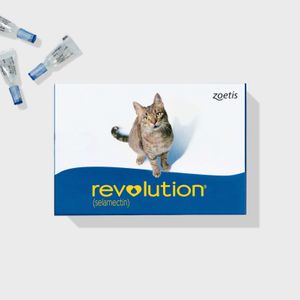
Selamectin is the active ingredient in Revolution, an FDA-approved topical parasite control product for cats. Your veterinarian may prescribe Revolution to your cat for the treatment, control, or prevention of certain internal and external parasites. Revolution treats and prevents fleas, prevents heartworm disease, and treats and controls ear mites, roundworms, and hookworms. Revolution is manufactured by Zoetis® and is available by prescription only.
Guidelines from both the Companion Animal Parasite Council (CAPC) and the Canadian Parasitology Expert Panel (CPEP) emphasize the importance of regular parasite protection for cats against heartworms, fleas, and intestinal parasites.
How it works and what it’s used for
After being applied to the skin on the back of a cat’s neck, selamectin is absorbed into the cat’s bloodstream and spreads to tissues throughout the body. It protects cats against several important parasites:
- Fleas: Kills adult fleas when they bite and feed on the cat’s blood, and reduces flea egg production, helping to break the flea life cycle over time
- Heartworms: Kills the immature larval stage of heartworms (transmitted by mosquitoes) before they can grow into adult worms that damage the heart and lungs
- Intestinal worms: Disrupts the neuromuscular systems of roundworms and hookworms, causing paralysis and death of the worms and allowing the cat’s body to expel them
- Ear mites: Kills the adult ear mites that live in a cat’s ear canal, quickly improving itching and irritation
Studies show that symptoms of flea allergies may also improve as a result of killing adult fleas. This includes a reduction of skin redness, hair loss, skin infection, and itchiness. Since flea saliva is a common allergen, vets often recommend treating cats who have allergic dermatitis for fleas year-round.
How is it given?
Revolution comes as a colorless or yellow liquid, contained in a small plastic tube and applied topically to the skin on the back of the neck. Each tube is for single use only. The tubes are available in three strengths, each corresponding to a weight range in cats.
The medication should not be applied to broken skin since it contains alcohol, which can further damage or irritate the skin. Revolution is not to be applied if your cat’s coat is wet, and a cat should not be bathed within 24 hours of a treatment; however, there’s been no investigation as to whether bathing a cat before application affects efficacy.
This is how Revolution is applied:
- Firmly press the cap down to puncture the seal (you will hear or feel it “click”), then remove the cap.
- Part your cat’s hair on the base of their neck above the shoulder blades so that the skin is visible.
- With the tip of the tube touching the skin, squeeze the tube three or four times to empty all its contents directly onto the skin (there is no need to massage the product into the skin).
- Once the tube is empty, discard it with your ordinary household waste.
A veterinarian or veterinary technician can demonstrate or give instructions for applying Revolution.
The Companion Animal Parasite Council (CAPC) recommends all cats in the US, including indoor cats, receive year-round parasite prevention. Pests can find their way indoors, and keeping your cat on continuous prevention helps protect both them and the rest of the household.
In Canada, veterinarians often follow recommendations from the Canadian Parasitology Expert Panel (CPEP). These guidelines are adapted to Canada’s climate and seasonal parasite risks. Depending on where you live, your vet may recommend you use prevention on your cat year-round or only during the warmer months, when certain pests are most active.
For flea prevention, give your cat Revolution year-round on a monthly basis or at least one month before fleas become active until one month after fleas stop being active in your region. If your cat already has fleas when Revolution is applied, the adult fleas die rapidly, often before they can lay eggs. However, it takes at least three months of regularly treating all pets in the household to eliminate an existing infestation because of flea eggs and pupae that are already present in the environment. If your vet prescribes Revolution for a flea infestation, be sure to tell them about any other animals in your home, since treating all pets in the home helps prevent a reinfestation.
To treat and control ear mites, administer Revolution to the skin over the shoulder blades, the same as for all other indications; it’s not applied to the ear canal. Ear mite eggs, like flea eggs, are resistant to treatment, so repeated monthly dosing over two or three months is necessary to eliminate ear mites. Regular, year-round monthly use prevents future ear mite infestations.
To treat intestinal roundworm and hookworm infections, apply Revolution as a single topical dose. Regular monthly application controls future infections.
Heartworm disease can be prevented by applying Revolution once a month year-round. Alternatively, it can be started within one month of your cat’s first exposure to mosquitoes, with the final dose being given within one month from their last exposure to mosquitoes. If your cat has an unknown heartworm history but tests negative for heartworm before starting Revolution, it’s possible the heartworm infection is present but still undetectable. In this case, a heartworm test is advised three to four months after starting Revolution. Cats who are already infected with adult heartworms can be given Revolution to prevent further infections. If replacing another monthly heartworm preventative product, the first dose of Revolution should be given within a month of the last dose of the former medication.
Side effects of Revolution in cats
Revolution is generally well tolerated in most cats. In some cats, stiff hair, clumping hair, hair discoloration, or a slight powdery residue may be seen at the treatment site. These effects are temporary and do not reduce the safety or effectiveness of Revolution.
Uncommon (less than 1% of cats) adverse effects from clinical studies include:
- Temporary localized hair loss (alopecia) at or near the application site
- Vomiting
- Diarrhea or loose stool (with or without blood)
- Appetite loss (anorexia)
- Lethargy
- Salivation
- Rapid breathing (tachypnea)
- Muscle tremors
Understanding side effects
Reading through the list of side effects may feel alarming, but it’s important to understand how these lists are created. In clinical studies, every symptom that occurs is recorded, whether or not the medication is the cause. For example, if a cat develops diarrhea while in a trial, it must be noted, even if the diarrhea was due to something unrelated. Cats receiving a placebo often show the same kinds of symptoms. Scientists compare these groups carefully to determine whether a medication is safe and effective.
Reported side effects are those that are reported to Zoetis by a veterinary professional or pet owner who has administered Revolution. Though the reported symptoms are seen after giving the medication, it’s difficult to confirm that the medication is the direct cause of the symptom noted.
The list of side effects is extensive, but it doesn’t mean your cat is likely to experience them. If you’re still unsure, your vet can help you weigh the risks and benefits for your unique situation.
Are side effects more likely to happen with the first dose?
Some side effects may appear soon after the first dose because it’s the first time the body has been exposed to the drug; others may not emerge until a medication is used for a longer period of time. Even if a symptom appears shortly after starting a new medication, your vet may need to investigate further to determine whether the medication is truly the cause.
What should I do if I notice changes in my pet right after starting a new medication?
If your pet shows new symptoms after starting a medication, veterinary input is key to understanding whether the change is related to the drug or from another cause. This is especially important if you see serious signs needing urgent action, like:
These are emergency signs. Even though these symptoms may not be directly related to this medication, they always need to be urgently evaluated by a veterinarian. Decisions about stopping the medication, adjusting the dose, or switching medications are safest when made with guidance from your vet.
Where can I find more information?
The drug label and package insert have the most significant information, including the list of side effects seen during scientific studies. These studies are done in a controlled environment, which means external factors are limited to prevent them from affecting the data. Clinical studies are designed to measure the benefits and potential risks of a medication.
Though the package label has extensive information, your vet is the best resource to guide you on whether this medication is right for your cat, since they can take into account your cat’s unique situation.
For more details about Revolution, visit the Zoetis website.
Drug interactions with Revolution
There are no known drug interactions for using Revolution with other medications. In studies, Revolution was used safely in animals receiving other frequently used veterinary products, such as vaccines, antiparasitics, antibiotics, steroids, collars, shampoos, and dips. No adverse reactions were associated with using Revolution at the same time as these medications. However, absence of evidence is not proof against all drug interactions. Always check with a veterinarian before giving your pet any new medications and make sure they are aware of all other medications and supplements you give your pet.
Risk factors
Studies show Revolution to have a strong safety profile. Revolution is generally well-tolerated in cats, but just like with any medication, some cats may be at more of a risk for side effects than others. Your veterinarian can determine whether Revolution is right for your cat. Some of the main concerns include:
- Age: Revolution is not for use in kittens under eight weeks of age.
- Existing and pre-existing health conditions: Revolution should not be applied to broken skin because it contains alcohol, which can further damage or irritate the skin. If your cat has an unknown heartworm history, your vet may recommend heartworm testing before starting Revolution. If your cat has an unknown heartworm history and tests negative for heartworm, your vet may recommend testing for heartworm three to four months after starting Revolution. If your cat has another chronic illness, always talk to your vet before starting any new medication.
- Revolution should not be used in sick, debilitated, or underweight cats.
- Pregnancy and nursing: No adverse effects are noted with the use of Revolution in breeding, pregnant, or lactating cats.
Veterinarians can take into account each cat’s specific health condition and circumstance. If at any time you have questions or concerns about the safety of a medication for your cat, your veterinarian can provide professional guidance tailored to your unique situation and your cat’s needs.
Safety and overdose information
There are important safety details you need to follow if you give your cat medications that contain selamectin.
Human safety
Revolution may be irritating to the skin and eyes. Reactions like hives, itching, and skin redness have been reported with accidental skin contact of topical selamectin solution. People who have a sensitivity to selamectin should use caution or consult a healthcare professional before using Revolution. Revolution contains isopropyl alcohol and the preservative butylated hydroxytoluene (BHT).
- This medication is not intended for use in humans; keep out of reach of children.
- Avoid contact between the product and skin. If accidental contact occurs, immediately wash the product off the skin with soap and water.
- Do not come into contact with or allow children to come into contact with the application site for four hours after application.
- If accidental human ingestion occurs, contact a physician immediately.
- In case of accidental eye contact, flush eyes copiously with water. If wearing contact lenses, rinse the eyes first then remove the contact lenses and continue to rinse for 5–10 minutes and seek medical attention.
Storage
- This medication is flammable; keep away from heat, sparks, open flames, or other sources of ignition.
- Store at or under 30° Celsius (86° Fahrenheit).
- Do not use after the expiration date on the label.
- Dispose of used tubes in your household trash.
Use and administration
- Use Revolution only as directed by a veterinarian and follow the label instructions exactly. The medication should not be stopped and doses should not be skipped unless directed to do so by a veterinarian.
- Verify that your pet’s species, age, and weight match the prescribed dose.
- Do not give Revolution to a cat with a known allergy to selamectin or any other ingredients listed.
Overdosage
Contact your veterinarian/a poison control center immediately if your cat receives more than the prescribed amount of Revolution.
Talk to your vet
Before starting Revolution, your vet needs to know if your cat has ever had a previous adverse reaction to selamectin.
When prescribing Revolution, your vet needs to be aware of every medication and supplement your cat receives, including over-the-counter products.This information helps prevent drug interactions, avoids duplicate therapies, and guides safe dosing and monitoring. It’s also important to let your vet know if your cat is pregnant or nursing, or if you plan to breed your cat.
Accidental ingestion by other pets or people
Veterinary prescription medications are prescribed for an individual pet. Before prescribing a medication, a vet takes into account a pet’s species, weight, age, physical examination, previously existing conditions, and other details. It’s unsafe to give a veterinary prescription to a human or to an animal other than the pet it’s prescribed for.
If another pet of any species, including another cat, accidentally receives or ingests the medication, contact a veterinarian, physician, or poison control center immediately for advice.
For complete safety and handling information, including situations when it might be harmful to use this medication, see the package insert for Revolution.
Emergency contacts:
- Pet Emergency: Contact your local emergency veterinary clinic
- Pet Poison Helpline: (855) 764-7661 (fee may apply)
- ASPCA Animal Poison Control: (888) 426-4435 (fee may apply)
- Human Poison Control: Contact your local poison control center or emergency services
- FDA Adverse Event Reporting: Report suspected adverse reactions to the FDA Center for Veterinary Medicine at 1-888-FDA-VETS or online at www.fda.gov/reportanimalae
- To report a suspected adverse reaction to a veterinary drug in Canada, contact the Veterinary Drugs Directorate (VDD) by calling 1-877-838-7322 or emailing pv-vet@hc-sc.gc.ca
- - Manufacturer: Contact Zoetis Services in Canada at 800-461-0917, in the US at 1-888-Zoetis1 (1-888-963-8471), in the UK at 0345 300 8034, or or visit https://www.zoetis.com/contact-us.
Missed dose
If a dose is missed, give it as soon as possible and then continue on the regular monthly schedule from there. Double doses or extra doses should not be given.
Alternatives to Revolution
Based on your pet’s individual circumstance and condition, your vet may recommend other kinds of medications and products in addition to or in place of Revolution. To make an informed decision, always discuss side effects, long-term effects, and how easy a product is to administer.
Alternative or additional treatments include:
- Prescription oral and topical (spot-on) medications
- Over-the-counter medications
- Topical treatments
Each product has different advantages and disadvantages and plays different roles in parasite treatment and prevention. Talk to a veterinarian to determine which options are right for you and your unique situation.
Associated conditions
When exposed to or infested with parasites, like fleas and intestinal worms, or disease vectors, like mosquitoes, a cat may be at risk for other conditions or diseases. If needed, your vet can recommend treatments additional to or in place of selamectin. Some commonly associated conditions and diseases include:
- Flea allergy dermatitis
- Atopic dermatitis
- Tapeworm
- Heartworm disease
- Gastrointestinal issues
- Anemia
- Respiratory issues
Other facts
- If anything unexpected happens when your cat is taking this medication, contact a veterinarian.
- Revolution should be used only for the pet it was prescribed for and only for the specific condition your veterinarian intended.
- Follow the exact dosing instructions. Never adjust the dose, split doses, or share the medication with other pets.
References
- Revolution (selamectin): Topical Parasiticide for Dogs and Cats
- Revolution Product Page
- Revolution Plus Prescribing Information
Regulatory information:
This product information is based on FDA-approved labeling. For the most current prescribing information, safety updates, and regulatory status, consult the official product labeling or contact the manufacturer directly.
This educational content was developed independently by our veterinary editorial team without financial compensation, input, or approval from any pharmaceutical manufacturer. All information is based solely on FDA-approved labeling, published scientific literature, and independent veterinary professional judgment. While our organization may have separate business relationships with pharmaceutical companies, these do not influence our editorial content or medical recommendations.
Our editorial committee


Online veterinarian and virtual pet care services available on-demand.
Available now on Apple and Play stores.