Hypoallergenic cat food: A beginner’s guide


With so many cat foods advertised as a solution to allergies, it’s easy to assume that switching your cat’s food is a quick way to fix their itchy skin, rash, or recurrent ear issues. Similarly, with the number of cat foods advertising benefits to skin and gut health, it’s easy to think a diet change is a good first step to help your cat’s irritated skin or ongoing stomach upset.
In reality, appropriate diet changes are rarely straightforward, and changing diets is unlikely to resolve the problem. In fact, most feline skin problems stem from conditions that have nothing to do with food.
Finding the right diet for your cat with skin or ear problems takes time and a solid understanding of how food allergies work, so getting guidance from a veterinarian helps you find the shortest pathway to relief for your feline companion.
If food isn’t the cause of your cat’s problems, switching diets unnecessarily can waste time and money and can even cause new problems. If you’re considering a “hypoallergenic” diet for your cat, this article clarifies what that term truly means, how food allergies are diagnosed, and how diet fits into a comprehensive treatment approach.
When allergy symptoms in cats aren’t caused by food
Many of the signs that owners associate with allergies in cats, such as itchy skin, ear irritation, vomiting, or diarrhea, are often caused by conditions that have nothing to do with allergies. Parasites, skin infections, digestive disorders, and other medical conditions can produce symptoms that look very similar to allergy-related problems. Because these signs can have many possible causes — including issues unrelated to both food and allergies — it’s important not to assume that a diet change alone will solve the problem.
It’s a common misconception that vomiting and diarrhea means a cat has a food allergy. While some cats with food allergies can develop digestive signs, skin symptoms, such as itching, are much more typical. In fact, most cases of vomiting or diarrhea in cats are caused by medical conditions, such as infections, parasites, inflammatory bowel disease, and dietary intolerance. For this reason, ongoing digestive symptoms should not automatically be attributed to a food allergy.
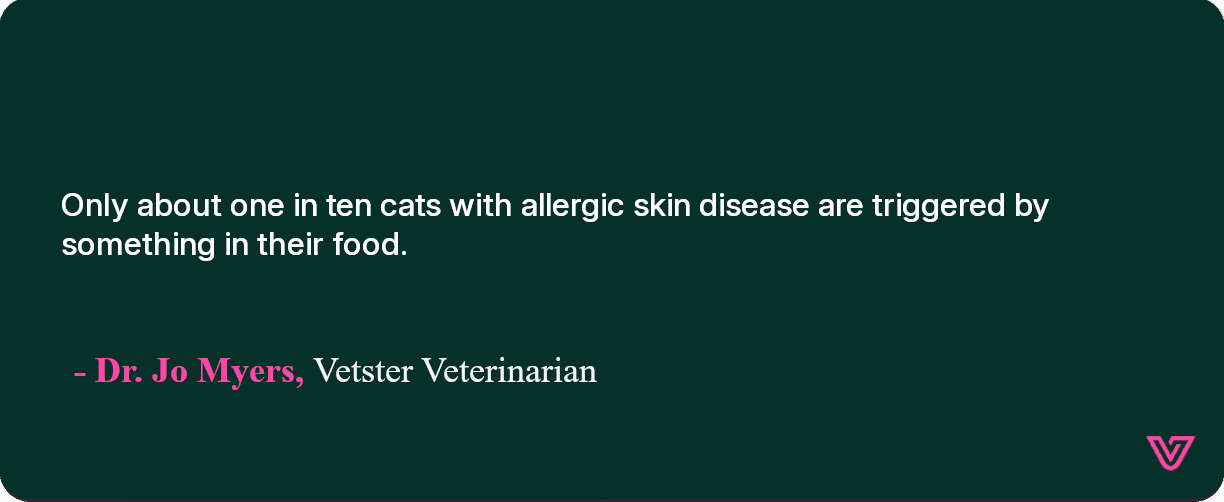
Even if your cat’s symptoms are due to allergies, it’s unlikely that their food is to blame. Only about one in ten cats with allergic skin disease are triggered by something in their food. Environmental triggers, like flea saliva, pollen, mold, or dust mites, are more often the cause.
For example, an allergy to flea saliva (flea allergy dermatitis) is the most common cause of itchy skin in cats, and it often occurs even when there are no visible signs of fleas. If a cat is reacting to flea saliva or something else in their environment, then changing their diet will not solve the issue. In most cases of allergic skin disease in cats, starting flea treatment typically resolves the symptoms.
Working with a vet is the best way to accurately understand what may be causing your cat’s symptoms and to determine the right treatment.
What does “hypoallergenic” actually mean?
When the word “hypoallergenic” appears on a pet food label, it’s important to understand that it is a marketing term and does not have a strict legal or medical definition. The American Association of Feed Control Officials (AAFCO) provides specific definitions for claims used on pet food packaging, but this term is not one of them. In other words, there isn’t anything a diet must contain or avoid in order for the manufacturer to put “hypoallergenic” on the label.
According to Dr. Jo Myers, a Vetster veterinarian, “a hypoallergenic diet is intended, in theory, to eliminate or lower the severity of an allergic reaction in the small percentage of cats who truly have a food allergy. In practice, however, the term doesn’t guarantee that a food will be appropriate for a cat with confirmed food allergies, mostly because it doesn’t actually describe anything about what the food does or does not contain.”
For this reason, vets don’t typically attribute any significance to whether or not a food claims to be hypoallergenic. What matters more is whether the food contains an ingredient your cat is allergic to. Suggesting a single diet formulation can help the majority of cats does not take into account how food allergies actually work. To properly prevent food allergy symptoms, a diet must be carefully selected for the individual cat and take into account what they’ve eaten before, their known allergies, and any other health conditions they have.
The 3 main types of allergy-friendly diets
The diets outlined below are intended for diagnosing or managing food allergies, but it’s important to remember that no diet can cure allergies in cats. In other words, a cat with an allergy to tuna is expected to remain allergic to tuna for their entire life.
However, for the small percentage of cats with confirmed food allergies, a carefully selected diet can help reduce or eliminate symptoms. Diet options can range from certain over-the-counter options to special therapeutic diets made under tightly controlled manufacturing standards.
Veterinarians may also use a specific diet as part of a dietary elimination trial, which is the gold standard for diagnosing food allergies. If a cat improves significantly during a properly conducted elimination trial, that diet may be recommended for long-term management.
Allergy-friendly diets for cats at a glance
| Diet Type | Description |
|---|---|
| Novel protein diet | Uses a protein source a cat has never been exposed to |
| Limited ingredient diet | Contains only one protein and one carbohydrate |
| Hydrolyzed protein diet | Protein is broken down into tiny fragments |
Novel protein diets
A novel, or new, protein is one that a cat has never been exposed to before in any form, including in their regular food, treats, or flavored medications or supplements. For example, kangaroo meat is likely to be a novel protein for most cats in North America.
The benefit of a novel protein diet is that it’s unlikely to provoke an allergic response. This is because food allergies in cats develop over time, with repeated exposure to the same protein. A cat cannot be allergic to a new food ingredient.
Because of this, when food allergies are suspected, it can be misleading to focus on what’s new in your cat’s diet. In many cases, the ingredient causing the reaction is actually something your cat’s been eating for months or even years before symptoms appear. Selecting a food with a new and different protein source is a good starting point for diagnosing and managing feline food allergies.
You won’t typically see the term novel protein written on cat food labels, because what’s new for one cat may not be new for another. “To choose a novel protein diet for your cat,” says Dr. Myers, “consider everything they’ve eaten in the past and avoid that.” Since this can be challenging for adopted pets with an unknown dietary history, a vet may recommend a diet with a less common protein source that your cat is highly unlikely to have been exposed to.
Why carbohydrates matter in food allergies
While proteins are the most common ingredients that trigger feline food allergies, carbohydrates can occasionally contribute as well. Because of this, some novel diets are formulated with both a new protein source and a less common carbohydrate.
The objective is to choose ingredients your cat has truly never eaten before, since any previously consumed ingredient, whether protein or carbohydrate, has the potential to trigger a reaction in a sensitized cat.
Standard over-the-counter cat food that does not include the proteins or carbohydrates your cat has previously eaten may qualify as a novel diet for your cat. However, many regular diets are often produced on shared equipment, which increases the possibility of cross-contamination with other ingredients. Also, ingredient sourcing may change between batches, and vague label terms, like “natural flavor” or unnamed animal by-products, can make it difficult to know exactly what’s included.
For cats with suspected or confirmed food allergies, this level of uncertainty can make it hard to confidently evaluate whether a diet is truly novel. When strict ingredient control is necessary, a vet may recommend moving to a more tightly regulated option, such as a vet-exclusive therapeutic or prescription diet that’s been formulated to simplify and standardize the ingredient list.
Limited ingredient diets
Limited ingredient diets simplify the diet’s ingredient list, making for fewer potential triggers for cats with food allergies. They contain only one protein along with one carbohydrate source and fewer additional ingredients, making it easier to select a novel food. Limited ingredient diets often have labels that advertise their main protein and carbohydrate sources, like venison and green pea or duck and pea.
It’s important not to confuse limited diets with novel diets. A limited ingredient diet simply means the food contains fewer ingredients, but those ingredients may still be ones your cat has eaten before. For a diet to help identify or manage a food allergy, the ingredients should be things your cat has never been exposed to before.
Some limited ingredient diets are sold over-the-counter, while others are prescription or therapeutic diets that require approval from a vet to purchase. Despite the terminology, they are not medications and are not regulated with the same rules as prescription drugs. Manufacturers use the term prescription to indicate the diet is intended to be used under veterinary guidance.
These diets are typically distributed through vets and are recommended as part of a structured medical plan, such as a dietary elimination trial or long-term allergy management strategy. This approach helps ensure the diet is selected for a medical purpose and used appropriately.
Hydrolyzed protein diets
A hydrolyzed protein diet is one where the proteins are broken down into smaller fragments so that the immune system no longer recognizes them. As a result, even though the diet still contains the necessary amount of protein, an allergic reaction is unlikely to occur. These diets are manufactured using careful ingredient sourcing and strictly controlled manufacturing conditions and equipment to minimize the risk of cross-contamination with other foods.
Veterinarians frequently rely on hydrolyzed diets during a dietary elimination trial, which is how food allergies are diagnosed. If a cat is known to have food allergies, the same diet may be continued for long-term feeding, even if the exact allergen is unknown.
Because hydrolyzed protein diets are used for diagnostic and treatment purposes, a recommendation from a vet is usually necessary to purchase them. As a result, they’re often referred to as “prescription diets,” even though they’re not a medication.
How to choose an allergy-friendly diet for your cat
When searching for a diet to support your cat’s allergies, here are some questions to ask yourself:
- Has a vet confirmed that my cat’s skin issues are related to allergies?
- Has a vet ruled out environmental allergies, parasites, infections, or other medical problems that may be contributing to my cat’s symptoms?
- Have my cat’s food allergies been confirmed through a dietary elimination trial, or am I able to pursue a dietary elimination trial?
- Do I understand the difference between a dietary elimination trial and simply switching foods?
- Which foods has my cat eaten or been exposed to in the past?
- Is the protein in this diet one that my cat has truly never eaten before, including in treats and medications?
- Does this particular food contain ingredients that may be hidden under different names (e.g., chicken meal, natural flavor, or beef broth)?
- Is the diet formulated to meet the AAFCO nutritional requirements for cat food?
- Does my cat have medical conditions in addition to allergies that require or could benefit from dietary management?
- If my cat does well on this diet, can I afford it long term?
- Is everyone in my household committed to strictly sticking to this diet?
Partnering with a vet to compare any diets you’re considering can make a big difference. They can help you to look beyond marketing claims, interpret labels, and assess nutritional values. By reviewing your cat’s dietary history, symptoms, health conditions, age, and lifestyle, you can work together to clarify which diet is the best fit.
Is grain-free the same as hypoallergenic?

A grain-free diet is not the same as a hypoallergenic diet. While a grain-free diet omits grains, it’s unlikely to help a cat with their food allergies.
“Some diets are marketed to suggest that the absence of grain can improve skin or digestive symptoms,” says Dr. Myers, “but this is rarely accurate. Though a grain-free diet may help a cat with an allergy to grains, grains are not a common trigger for feline food allergies.” Most cats with food allergies are reacting to proteins, such as beef, pork, chicken, fish, or dairy products. Both grain-free and grain-inclusive diets can trigger an allergic reaction if they contain ingredients your cat is allergic to.
As Dr. Myers notes, “For the majority of cats, there is no medical reason to choose a grain-free diet, unless it’s part of a specific therapeutic plan recommended by your veterinarian. A vet may recommend a therapeutic limited ingredients diet that also happens to be grain-free. In this case, the purpose of the diet is to diagnose or treat allergies with a food that is novel for that cat, not simply because it is grain-free.”
Is store-bought food effective?
Where a food is bought does not determine whether it will help a cat with a food allergy. The term store-bought generally refers to over-the-counter (OTC) diets available at pet stores or online, without veterinary approval. In contrast, some diets are marketed as therapeutic or prescription diets. These products usually require veterinary authorization or approval to purchase.
Both OTC and therapeutic diets can be effective for managing food allergies, as long as they avoid the specific ingredient(s) your cat is allergic to and are appropriate for your cat’s medical needs. The critical factor is not where the food is purchased but what’s in it and whether it’s appropriately formulated.
Why the ingredient list matters
It’s worth noting that some OTC foods that are labelled as “hypoallergenic” for a “sensitive stomach” use fish as the primary protein source. This can be problematic, since fish allergies are common in cats with food allergies. Again, the most important factor in managing food allergies is avoiding the offending ingredient.
Examining the ingredient list closely is essential. Even trace amounts of an allergen can provoke a reaction, regardless of whether the allergen appears first or last on the ingredient list. For example, a cat with a fish allergy can have the same allergic reaction to a diet that contains whole fish as to one containing fish flavoring.
The risks of cross-contamination
Another potential issue with many OTC diets is cross-contamination. Several different diets may be manufactured on shared equipment, which can allow for unintentional inclusion of potential allergens.
Because even trace amounts of an ingredient your cat is allergic to can trigger an allergic reaction, vets often recommend a prescription therapeutic diet for elimination trials. These diets have a strictly controlled manufacturing process to minimize the chance of hidden or unintentional ingredients, which helps support a more accurate interpretation of trial results.
Choosing the right food for your cat
Finding the right diet for your cat can take time. Reading the food label is very important, but focus needs to be put on nutritional quality rather than marketing terms. A diet can only be truly hypoallergenic or allergy-friendly if it’s selected based on your cat’s unique history and needs.
Caring for your cat’s skin and gut involves more than just avoiding allergens. It also involves providing essential nutrients that support skin and coat health and manage inflammation, including vitamins, minerals, and omega-3 and omega-6 fatty acids.
A veterinary consultation is the best way to determine whether your cat’s skin or digestive problems are related to allergies. Many of the symptoms owners associate with allergies, such as itching, ear problems, vomiting, or diarrhea, can also be caused by infections, parasites, digestive disorders, and other medical conditions.
Even when there is an allergy, environmental triggers are far more common than food. If a food allergy is suspected and identifying the exact trigger would be helpful, a vet may recommend a dietary elimination trial to reach a diagnosis. These trials require you to strictly control everything your cat eats, must be followed consistently for an extended period of time, and can be difficult to interpret, so professional guidance is very helpful.
If your cat’s condition is related to allergies, a Vetster veterinarian can help evaluate your cat’s dietary history, symptoms, health conditions, age concerns, and lifestyle to determine which diet best suits your cat.
FAQ
What are the most common food allergies in cats?
Cats are most commonly allergic to one or more proteins in their food. Some of the most common sources of food allergies in cats include beef, pork, chicken, fish, and dairy products. Allergies to grains and other carbohydrates are less common. Even treats, medications, and supplements must be monitored closely for ingredients that can trigger a reaction in a cat who has food allergies.
Can I buy a hydrolyzed protein diet at the grocery store?
Hydrolyzed protein diets are therapeutic diets, which typically require approval from a veterinarian to purchase, so they are not widely available at grocery stores. They are produced using precisely controlled ingredients and equipment, under conditions that eliminate the risk of cross-contamination with other foods.
Can feeding a variety of proteins help my cat with allergies?
Rotating between different foods does not prevent or treat food allergies. Most allergies in cats are unrelated to the food and are caused by allergens in the environment, such as flea saliva, grass, pollens, and molds. While food allergies develop over time after repeated exposure to the particular ingredient, there is no evidence that switching foods frequently or giving a variety of diets prevents food allergies from developing. In fact, frequently changing a cat’s diet limits the number of proteins available for use as a novel protein in the future.