How to prevent and treat taurine deficiency in cats


Taurine is an amino acid essential for normal heart, eye, and brain function in cats. Because cats, unlike dogs and humans, aren’t able to produce their own taurine, it has to be ingested in their food. Taurine deficiency used to be a common cause of eye and heart disease in cats, but thanks to modern nutrition standards, it’s now rare. However, if your cat has been diagnosed with heart disease, you might wonder whether taurine plays a role and whether your cat’s diet provides enough of it. When discussing your cat’s diet with a vet, some questions you may have include:
- What is taurine, and why does my cat need it?
- How do I know if my cat has a taurine deficiency?
- What’s the treatment for taurine deficiency in cats?
- Am I doing enough to prevent a taurine deficiency in my cat?
Feeding your cat a diet with the Association of American Feed Control Officials (AAFCO) statement of nutritional adequacy on the label is the best way to ensure your cat is getting enough taurine to prevent a deficiency. Likewise, treatment for a taurine deficiency usually involves switching a cat to a nutritionally complete diet. Taurine deficiencies in cats can lead to dilated cardiomyopathy (DCM) — a severe form of heart disease — hearing loss, and changes in eyesight from retinal degeneration. A virtual vet appointment is a convenient way to check in with a veterinary professional to ensure your cat’s diet is nutritionally complete.
What is a taurine deficiency?
If your cat has a taurine deficiency, that means there’s not enough taurine in their body to keep them healthy. Taurine is an amino acid that keeps a cat’s eyes, heart, and brain healthy. Since cats can’t synthesize their own taurine, it’s essential they get enough of it in their diet. Unlike other amino acids that are used to build proteins, taurine circulates freely on its own and plays an active role in:
- Normal heart rhythm
- Healthy vision
- Brain development
- Fat digestion
Taurine in cat food is supplied by animal proteins, such as:
- Meat, such as chicken, beef, and turkey
- Seafood
- Eggs
- Milk and dairy products
When commercial cat foods were first developed in the mid-twentieth century, nutritionists didn’t yet know that cats require dietary taurine and that they’re unable to synthesize it from other amino acids like dogs and people. Because of this, early cat foods sometimes contained inadequate taurine levels, particularly those based on plant proteins or heavily processed ingredients. In the 1970s and early 1980s, veterinarians began noticing unusually high rates of dilated cardiomyopathy (DCM) and retinal damage in cats. Research soon confirmed that taurine deficiency was the cause, leading to widespread reformulation of cat foods in the late 1980s. Since then, diet-related taurine deficiency and DCM have become rare in cats fed commercial, nutritionally complete diets.
Cats at risk for taurine deficiency
Taurine deficiency is currently rare, especially for healthy cats eating the most common commercially available cat foods. Cats at risk for not eating enough taurine are those who:
- Primarily eat dog food
- Eat a diet without an AAFCO statement of nutritional adequacy on the label, such as some boutique, vegetarian, or vegan foods
- Eat mostly table scraps, treats, and snacks instead of a complete and balanced cat food
- Eat a homemade diet that was not formulated with the help of a veterinary nutritionist
If your cat is healthy and primarily eats a commercial cat food with an AAFCO statement of nutritional adequacy on the label, their risk of taurine deficiency is very low.
Diagnosing and treating taurine deficiency in cats
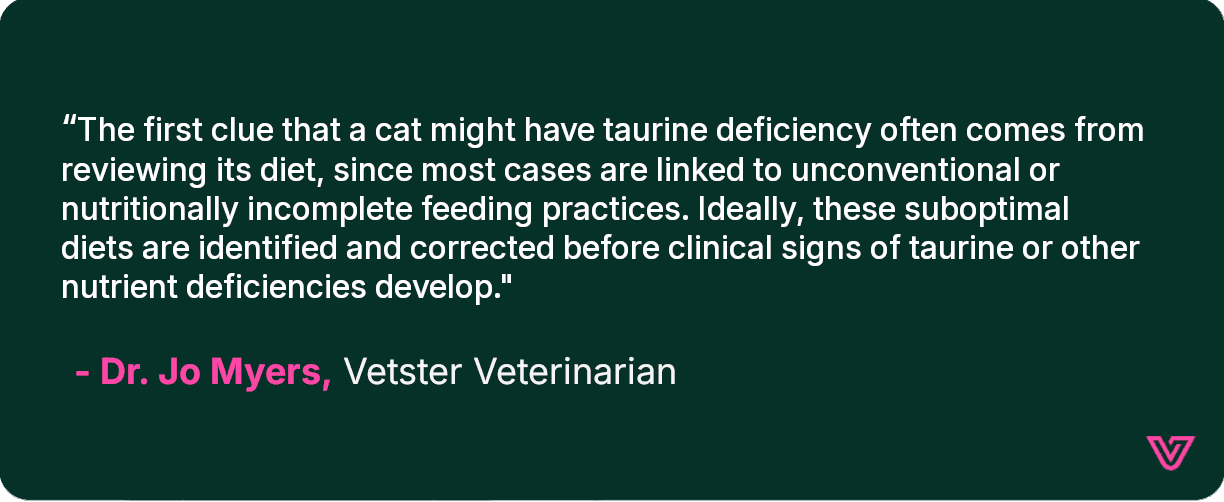
“The first clue that a cat might have taurine deficiency often comes from reviewing its diet, since most cases are linked to unconventional or nutritionally incomplete feeding practices,” explains Dr. Jo Myers, a veterinarian on the Vetster platform. “Ideally, these suboptimal diets are identified and corrected before clinical signs of taurine or other nutrient deficiencies develop.” Taurine can affect multiple bodily systems in cats, so clinical signs can vary depending on which syndrome develops due to the deficiency. Deficiency in taurine can lead to:
- Dilated cardiomyopathy (DCM): Weakening and dilation of the heart wall muscles, leading to poor cardiac output
- Retinal degeneration: Progressive loss of vision cells in the retina, resulting in gradual vision loss and eventual blindness
- Reproductive failure or poor growth in kittens: Decreased fertility, fetal resorption, stillbirth, or poor growth in young cats born to taurine-deficient queens
Taurine deficiency in cats most often leads to DCM, which is the most serious concern. Signs of DCM in cats include:
- Rapid breathing or difficulty breathing
- Lethargy
- Loss of appetite
- Exercise intolerance
- Pale gums
- Coughing
- Collapse or loss of consciousness
- Weakness
Taurine deficiency is not the only cause of DCM in cats, and these signs can also occur with other diseases. It’s important to seek immediate veterinary care if your cat shows any of these symptoms. Many cats do not show symptoms of DCM until the condition is severe and they’re in congestive heart failure.
Most cats with DCM have normal taurine levels, and most cases of feline DCM are considered idiopathic, meaning the exact cause is unknown. These idiopathic cases may involve genetic factors, myocarditis, or other poorly understood metabolic abnormalities, but none are consistently proven.
Taurine deficiency may also lead to retinal degeneration in cats, producing vision loss, with signs that may include bumping into objects or a reluctance to jump, or blind kittens if born from a deficient mother.
Reproductive issues due to a lack of taurine in the diet include:
- Decreased fertility
- Fetal resorption
- Stillbirth
- Poor growth and development in kittens born to deficient mothers
When a cat presents with symptoms of DCM, stunted growth, or changes in eyesight or hearing, a veterinarian usually starts with a physical examination and diagnostic testing. Blood taurine tests are often recommended for cats who present with symptoms of DCM or who are eating a nontraditional diet.
Taurine deficiency, like other nutritional deficiencies, develops over time, and clinical signs are often not apparent until the deficiency has severely affected the body. Treatment depends on the underlying cause of the deficiency but usually involves changing the diet to something that’s nutritionally complete. Taurine supplementation outside of a nutritionally complete diet is not usually a necessary part of treatment.
How to prevent taurine deficiency in cats
The best way to prevent a taurine deficiency in your cat is to feed them an appropriate diet. Look for a cat food with the AAFCO statement of nutritional adequacy on the label and feed your cat the appropriate amount based on their size. These diets are designed to be nutritionally balanced for the majority of healthy cats within the given life stage. Most modern, commercially available cat foods carry this label, which makes preventing taurine deficiency straightforward in the vast majority of cases.
It isn’t always easy to tell whether a commercial food truly meets your pet’s nutritional needs. Pet food labels can be confusing. Marketing claims like “premium,” “natural,” or “gourmet” aren’t regulated, and the rules for labeling pet foods focus mostly on ingredient listing and basic guarantees rather than on health claims. The most reliable indicator of quality is the AAFCO nutritional adequacy statement, which confirms that the diet has been tested or formulated to meet established nutrient requirements for cats.
If you’re unsure how to interpret a label or whether your cat’s diet meets these standards, a virtual veterinary appointment can be a convenient way to get expert advice from home. A vet can explain what the information on the label really means, help you choose a diet that meets your cat’s needs, and discuss how proper nutrition can prevent serious illnesses like taurine deficiency and heart disease.
When to talk to a vet about your cat’s diet
It’s a good idea to talk to a veterinarian any time you have concerns about your cat’s diet. Good nutrition is necessary for a cat’s health. Switching diets or adding dietary supplements when you have a health or dietary concern can do more harm than good, especially if a diet change is unnecessary to begin with. Cats with certain health issues, kittens, and senior cats may need special diets based on their condition and life stage. If you want to make sure your cat’s food is nutritionally complete or you need help choosing a healthy diet for your cat, an online vet is a convenient way to talk to a professional and get advice.
FAQ - Cat food, taurine, and preventing nutritional deficiencies
What is the best source of taurine for cats?
Taurine naturally occurs in animal-based proteins such as meat, fish, eggs, and dairy. Healthy cats fed a commercial diet that carries an AAFCO statement of nutritional adequacy receive all the taurine they need from their food. These diets are carefully formulated to meet established nutrient requirements for each life stage, so additional taurine supplements are not necessary unless prescribed by a veterinarian.
Can a cat’s taurine deficiency be treated?
Yes. Taurine deficiency develops when a cat’s diet does not provide enough taurine over time. Treatment focuses on restoring adequate taurine levels by switching to a nutritionally complete and balanced diet. In some cases, veterinarians may also recommend taurine supplementation or address other health problems that interfere with eating or digestion. With prompt treatment, many cats show improvement once their taurine levels return to normal.
What are the symptoms of taurine deficiency in cats?
Taurine deficiency most often affects the heart, vision, and, in some cases, hearing. The most common consequence is dilated cardiomyopathy (DCM), a serious form of heart disease. Cats with DCM may not show obvious signs until the disease is advanced, but when symptoms do appear, they can include rapid or labored breathing, open-mouth breathing or panting, weakness, lethargy, pale gums, or even collapse and fainting.
Retinal degeneration caused by taurine deficiency leads to gradual vision loss. Affected cats may hesitate to jump onto furniture, bump into objects, or seem less confident in dim lighting as their eyesight worsens. Hearing loss is less common but may cause a cat to stop responding to familiar sounds, appear startled when touched unexpectedly, or meow more loudly than usual.
Any of these signs should prompt immediate veterinary evaluation. A veterinarian can assess heart function, check taurine levels, and begin treatment to help prevent further damage.
Disclaimer: This article, its content, and its related references do not constitute veterinary advice and should not be considered a substitute for veterinary care. If your pet is showing any symptoms that could indicate a medical emergency, please seek immediate emergency care.